Coverage & Credibility
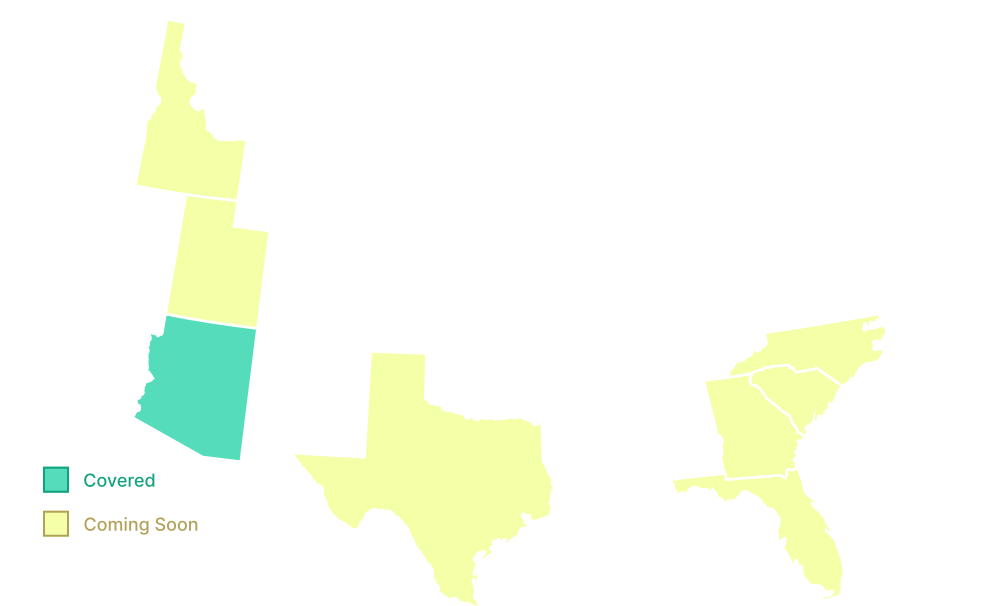
Growing coverage.
ChatAEC is built by professionals who have worked across real estate, planning, architecture, and development — and understand firsthand how complex and time-consuming regulatory research can be.



.svg)
.svg)
.svg)
.svg)
.svg)





You absolutely can, and many people do. But here’s what you’ll run into:
General LLMs don’t have current, city-specific data.
ChatGPT and Claude have knowledge cutoffs and don’t automatically pull live zoning codes, planned overlays, or general plan designations. You’d need to manually feed them the right documents, and even then you’re often working with outdated county-level data instead of current city regulations.
You have to do the research before you can ask the question.
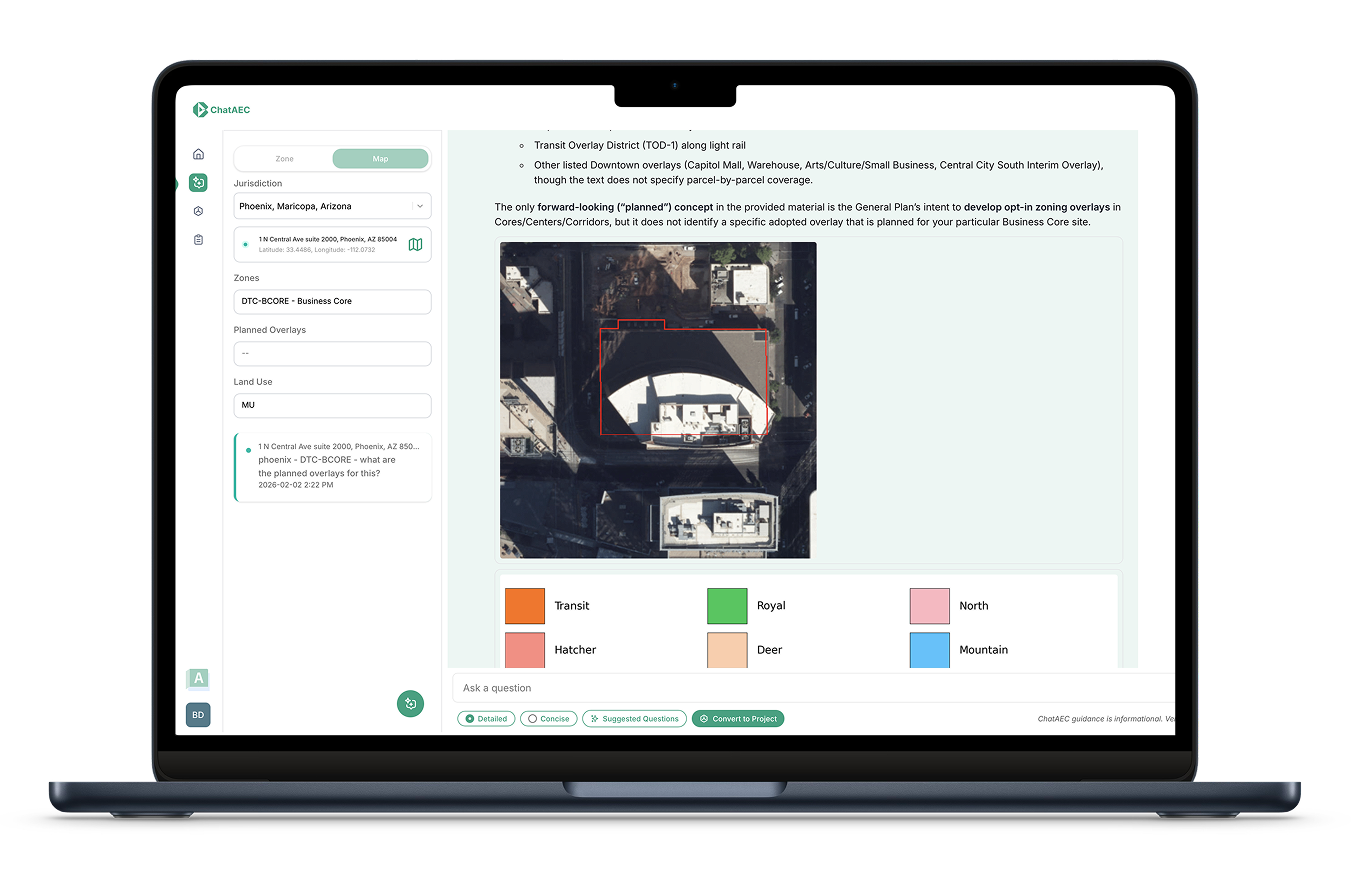
With a general LLM, you still need to track down zoning codes, municipal codes, and planning documents yourself. ChatAEC already has that data indexed and ready — you just ask the question and get an answer based on the most current city-level information.
No built-in AEC workflows.
General LLMs are powerful, but they aren’t designed around the workflows of architects, engineers, developers, and planners. ChatAEC is purpose-built for due diligence, feasibility analysis, zoning research, and permit planning, so outputs are structured for how you actually work.
Speed and reliability matter.
When you’re evaluating a site or preparing a submittal, you need answers fast and you need them to be right. ChatAEC is optimized for this — pulling the right data, summarizing it accurately, and delivering it in a format you can act on immediately.Think of it this way: You could use a general LLM the same way you could use Google. But just like you wouldn’t piece together a zoning analysis from 15 different search results, you don’t want to spend time prompting and re-prompting a general AI when you could get a complete, accurate answer in seconds.
ChatGPT and Claude have knowledge cutoffs and don’t automatically pull live zoning codes, planned overlays, or general plan designations. You’d need to manually feed them the right documents, and even then you’re often working with outdated county-level data instead of current city regulations.
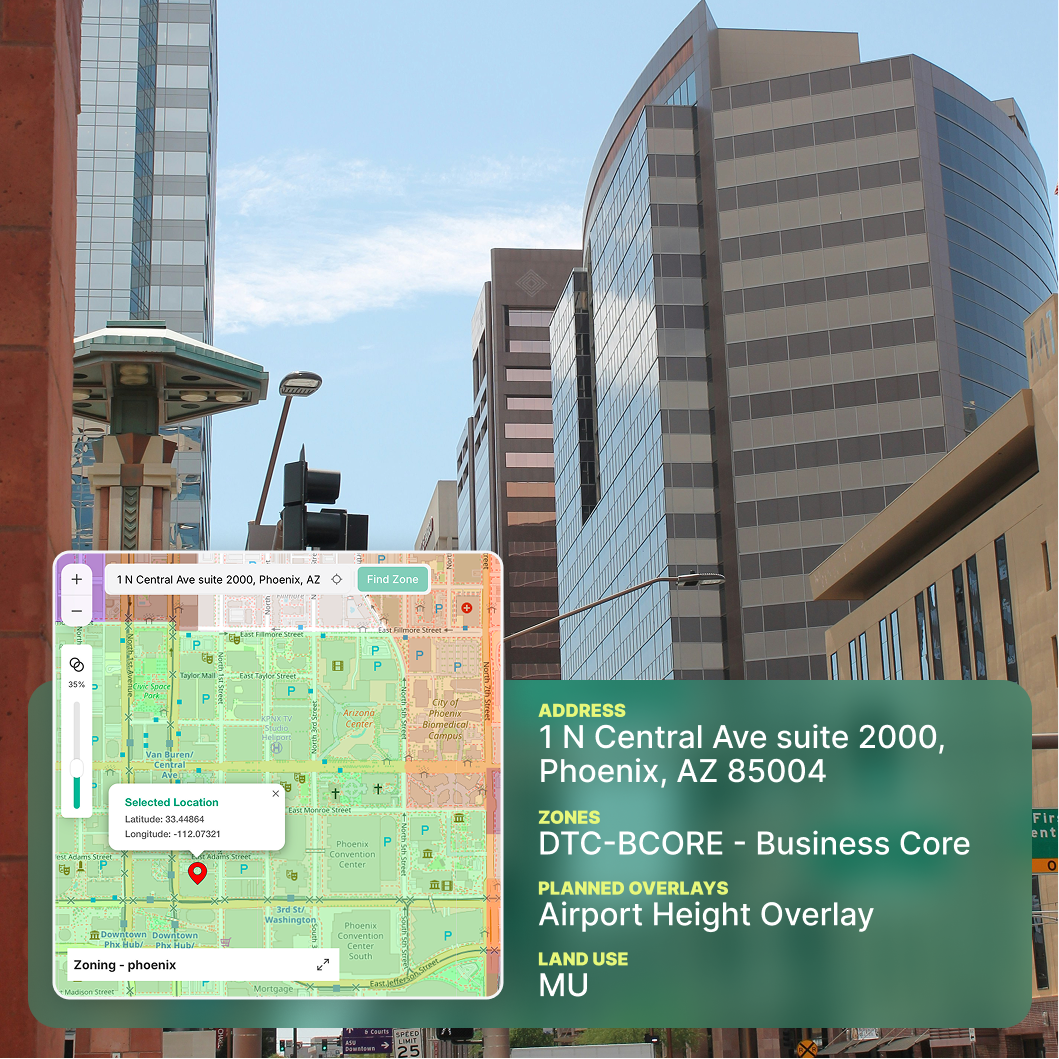
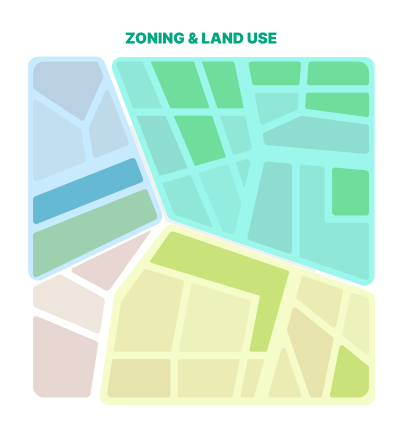
You can locate parcels by address, APN, or coordinates. You can also review our maps and drop a pin. Sites can be found using zoning maps, overlay maps, or general plan maps.
There really aren’t constraints during early-stage design and development research, but most questions fall into a few common buckets:
What’s allowed? (zoning, uses, density)
What are the constraints? (setbacks, overlays, environmental)
What’s the process? (permits, timelines, fees)
Is this feasible? (can I build X on Y parcel?)
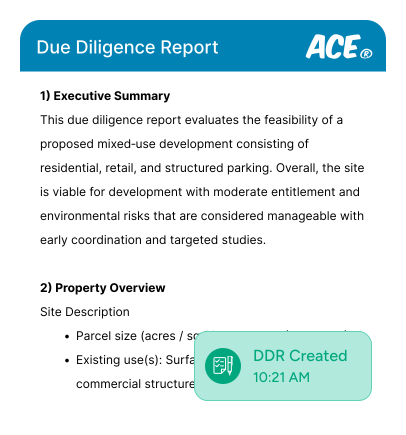
Give me everything. (due diligence reports, summaries)
ChatAEC interprets zoning codes, land-use regulations, and development standards for any parcel in its coverage area. You can ask about zoning designations, permitted uses, height and density limits, setbacks, parking requirements, overlay zones, environmental constraints, and preliminary site feasibility like allowable floor area and buildable area. It pulls together everything you’d normally have to dig through multiple documents to find — and gives you a clear answer in seconds.
We go straight to the source, the cities themselves. ChatAEC pulls zoning codes, land-use regulations, general plan designations, and overlay information directly from municipal sources, not outdated county databases or third-party aggregators. That means you're working with the most current, accurate, city-level data available.